TL;DR: Water damage restoration in Chicago takes 3 to 5 days for a small, contained loss with clean water. Add 2 to 5 more days if drywall needs to come out, hardwood floors are saturated, or a finished basement is involved. The drying phase ends when a moisture meter confirms the structure has reached its dry standard, not when the space looks or feels dry. Mold can begin growing within 24 to 48 hours of a water event, so the clock starts the moment water touches your building materials.
If you just had a pipe burst in your Logan Square two-flat or woke up to a flooded finished basement in Bridgeport, the first question everyone asks is: how long is this going to take? The honest answer depends on what got wet, how long it sat, and what the structure is made of. Here is a realistic day-by-day breakdown so you know what to expect, and what to watch for if the timeline starts to stretch.
Why does the 24 to 48 hour window matter so much?
Mold can begin colonizing wet building materials within 24 to 48 hours of a water event, according to the EPA’s guide on mold and moisture. That window is not a worst-case estimate. It is the realistic threshold for drywall, wood framing, and carpet padding held at room temperature with any moisture present. In a Chicago home where humidity is already elevated heading into fall, that clock runs fast.
This is why the first response call matters more than people realize. Getting extraction equipment on-site the same day limits how deep moisture migrates into wall cavities and subfloors. Every hour of delay extends the drying timeline and raises the odds that mold remediation becomes a second project on top of the first.
What does the day-by-day timeline actually look like?
A typical water damage restoration job in Chicago moves through five phases. The timeline below assumes a Category 1 loss (clean water from a supply line or appliance) in a single room or two. Category 2 (gray water from a dishwasher or washing machine) and Category 3 (sewage or floodwater) add time and scope at every phase.
Day 1: Emergency response and extraction
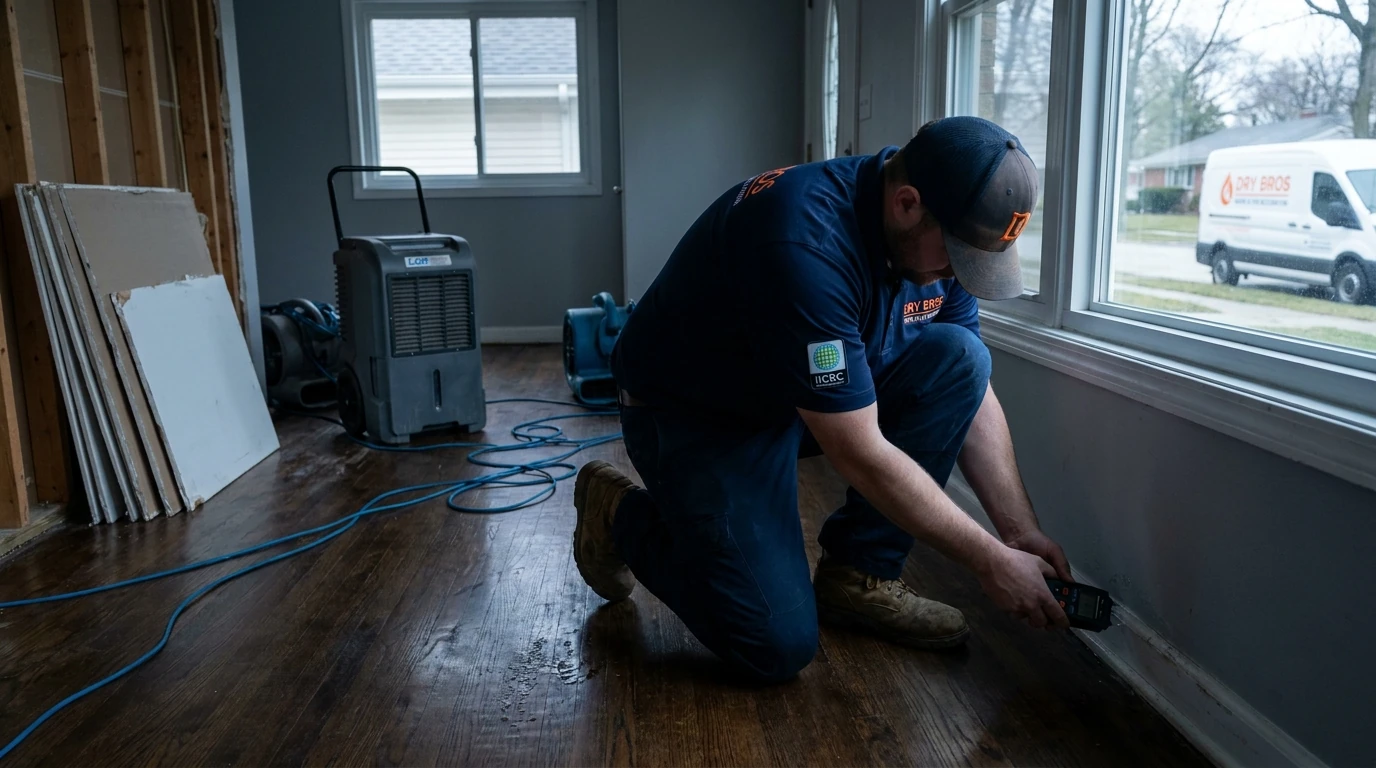
The crew arrives, assesses the loss, and begins water extraction immediately. A truck-mounted extractor or portable unit pulls standing water out of carpet, flooring, and low-lying areas. Moisture meters and thermal imaging cameras map how far water has migrated into walls and subfloors. Containment is set up if needed. By the end of Day 1, standing water is gone and the drying equipment is staged.
Days 2 to 3: Active structural drying
High-velocity air movers and LGR (low-grain refrigerant) dehumidifiers run continuously, 24 hours a day. The crew monitors moisture readings daily. The goal is to drive the structure’s moisture content down to the IICRC S500 standard for dry conditions, which for wood framing is typically 12 to 16 percent moisture content depending on the material and region. You cannot rush this with more equipment than the space needs. Over-drying one area while another stays wet just redistributes the problem.
Days 3 to 5: Monitoring and adjustments
For a contained, single-room loss with no drywall removal, most structures reach target moisture readings between Day 3 and Day 5. The crew adjusts equipment placement based on daily readings. When every monitored point hits the dry standard, equipment comes out and the job moves to documentation and closeout.
What extends the timeline beyond 5 days:
- Wet drywall that cannot be saved and must be removed (demo, dry the cavity, then replace)
- Hardwood floors, which absorb and release moisture slowly and may need 7 to 10 days or longer
- Finished basements with multiple material layers: carpet, pad, concrete slab, framed walls, insulation
- Water that sat for more than 12 to 24 hours before extraction began
- Chicago’s fall humidity, which slows evaporation and puts more load on dehumidifiers
How long does it take to dry out a house after water damage?
For a typical single-room loss in a Chicago home, the structural drying phase takes 3 to 5 days. Larger losses, saturated hardwood, or finished basement framing push that to 7 to 14 days. No reputable restoration company can give you a guaranteed end date on Day 1 because the timeline is driven by daily moisture readings, not a calendar. Anyone who promises “done in 48 hours” without seeing the moisture data is guessing.
The variables that matter most:
- Material type. Concrete dries slowly. Hardwood dries very slowly. Drywall dries faster but often cannot be saved once paper facing is saturated.
- Depth of penetration. Water that sat for 6 hours behaves very differently than water that sat for 36 hours. The longer it sits, the deeper it wicks into wall cavities and subfloor assemblies.
- Ambient conditions. Chicago in September can swing from 85 degrees and humid to 55 degrees and dry in the same week. Dehumidifier output drops significantly in cooler temperatures, which affects drying speed.
- Ventilation. Finished basements with low airflow are the hardest spaces to dry in the Chicago housing stock.
How long after water damage does mold grow, and what causes the musty smell?
Mold growth can begin within 24 to 48 hours on wet organic materials like drywall paper, wood framing, and carpet backing. The musty smell that homeowners notice after water damage is often mold already starting to colonize, not just residual dampness. If you are detecting a musty odor 3 to 5 days after a water event, that is a signal worth taking seriously.
Wet drywall is the highest-risk material in most Chicago homes. Once the paper facing absorbs water, mold spores already present in the environment find a ready food source. If a moisture reading on drywall is still elevated after 48 hours of active drying, most restoration technicians will recommend removing it rather than continuing to dry in place. The cost of demo and replacement is almost always less than the cost of remediating an established mold colony behind intact walls.
If a musty smell persists after the structure is confirmed dry, that is a separate problem. Odor that survives drying usually means mold has already established in a wall cavity, under flooring, or in HVAC ductwork. At that point, odor removal and a mold assessment become the next steps, not more drying time. Our post on 7 Signs You Have Hidden Mold covers what to look for if you suspect the smell is more than residual moisture.
What does water damage restoration actually include?
Water damage restoration is not just drying. A full-scope job under the IICRC S500 standard includes:
- Emergency extraction - removing standing water with truck-mounted or portable extractors
- Moisture mapping - thermal imaging and pin/pinless meters to document the extent of saturation
- Controlled demolition (when needed) - removing unsalvageable drywall, flooring, or insulation to expose wet cavities
- Structural drying - air movers, LGR dehumidifiers, and drying mats for hardwood floors
- Daily monitoring - readings documented at each visit to track progress toward the dry standard
- Antimicrobial treatment - applied to affected surfaces to inhibit mold growth during the drying window
- Final documentation - a written drying log with before and after moisture readings, which your insurance adjuster will request
That last item matters more than most homeowners realize. A complete drying log is the paper trail that supports your insurance claim and protects you if a mold issue surfaces six months later. Our post on water damage restoration cost in Chicago covers what insurance typically covers and what documentation adjusters look for.
If you are in the middle of a loss right now, the water damage restoration page has the fastest way to reach Dry Bros Water & Fire Restoration at (877) 379-2767, available around the clock.
About Dry Bros Water & Fire Restoration
Dry Bros Water & Fire Restoration is a licensed and insured restoration company serving Chicago, IL and surrounding communities including Evanston, Oak Park, Naperville, and Cicero. The company handles water damage restoration, flood damage restoration, basement flooding cleanup, burst pipe repair, sewage cleanup, mold remediation, fire and smoke damage restoration, odor removal, storm damage restoration, emergency board-up and tarping, and contents restoration. Dry Bros operates 24/7 and provides written scopes and drying documentation for every job.