TL;DR: Water damage restoration follows six phases: inspection and damage classification, water extraction, structural drying with air movers, dehumidification, antimicrobial treatment, and final repairs. The entire process takes 3 to 7 days for most residential losses, though heavily saturated materials or hidden moisture can extend that timeline. Every phase is governed by the IICRC S500 Standard for Professional Water Damage Restoration, the industry’s baseline for what “done” actually means.
Your basement flooded, or a supply line burst behind the refrigerator, or the upstairs toilet overflowed and soaked through the subfloor. You have water somewhere it should not be, and now you are wondering what the next several days actually look like. This post walks through every phase of the water damage restoration process the way a certified crew would explain it to you on-site, including what they are measuring, what equipment they are running, and why each step matters before the next one starts.
What happens during the inspection and damage assessment?
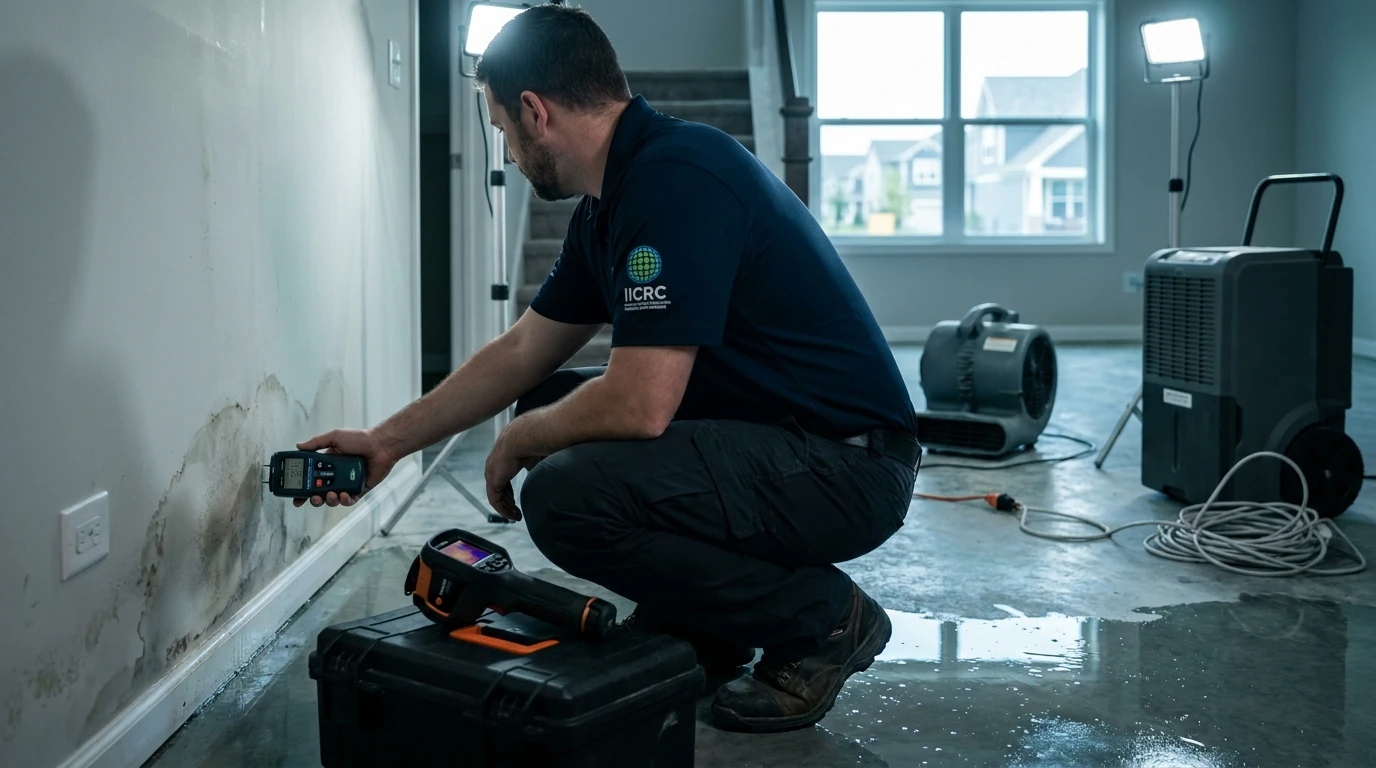
A restoration crew’s first job is not to start extracting water. It is to understand exactly what they are dealing with before they touch anything. During the inspection phase, technicians classify the water source and map how far moisture has traveled using thermal imaging cameras and pin-type or pinless moisture meters.
The IICRC S500 standard defines three water categories that determine how aggressively the crew must work:
- Category 1 (clean water): Broken supply lines, appliance failures, or overflowing sinks. Lowest contamination risk.
- Category 2 (gray water): Dishwasher or washing machine discharge, toilet overflow with urine only. Contains microorganisms and requires more careful handling.
- Category 3 (black water): Sewage backups, floodwater from outside, or any water that has sat long enough to grow bacteria. Requires full PPE and antimicrobial protocols from the start.
The crew also assigns a water damage class (1 through 4) based on how much material is saturated. A Class 1 loss is a small area with minimal absorption. A Class 4 loss involves hardwood floors, concrete, or plaster that has absorbed deeply and requires specialty drying techniques. These two numbers, category and class, drive every decision that follows.
In Naperville, a large share of residential losses involve finished basements. Homes in subdivisions near the DuPage River corridor and around neighborhoods like Brookdale and Cress Creek often have full lower levels with drywall, carpet, and built-in cabinetry. That means a single sump pump failure can produce a Class 3 or Class 4 loss even when the water source is clean.
How does water extraction work?
Once the scope is documented, extraction begins. Truck-mounted extractors pull water out at rates that no shop vac or consumer-grade pump can match, typically 100 gallons per minute or more. Portable extractors handle areas the truck unit cannot reach.
For carpet and padding, technicians use weighted extraction tools that press down to pull water from the lower layers of the carpet system. In most cases, carpet padding is removed and discarded because it retains moisture that cannot be extracted efficiently and becomes a mold substrate within 24 to 48 hours. The carpet itself may be salvageable depending on the water category and how long it has been wet.
For hard flooring, technicians use flat extraction heads and, in some cases, specialty mats that draw moisture up through the surface. Hardwood floors that have not yet cupped or buckled can sometimes be dried in place using this method, but the window is short. After 48 to 72 hours, hardwood that has absorbed water typically requires replacement.
If you had a burst pipe and have not yet addressed the source, see our burst pipe emergency checklist for the steps to take before the crew arrives.
How does structural drying actually work?
Extraction removes standing water. Structural drying removes the moisture that has absorbed into walls, floors, ceilings, and framing. These are two separate problems that require two separate tools.
Structural drying relies on high-velocity air movers, also called axial fans or snail fans depending on the model, positioned to create a vortex of air across wet surfaces. The moving air accelerates evaporation by constantly replacing the humid air layer sitting against a wet surface with drier air from the room. Technicians calculate how many air movers a space needs based on square footage and the class of loss, not by guessing.
Dehumidifiers run alongside the air movers to capture that evaporated moisture before it re-deposits on other surfaces. Low-grain refrigerant (LGR) dehumidifiers are the industry standard for most residential losses. They pull moisture from the air and drain it continuously, keeping the grain-per-pound reading in the room low enough that evaporation from wet materials can continue at a useful rate.
The crew sets up drying chambers when possible, using poly sheeting to isolate the affected area so the equipment is not trying to dry the whole house. A typical bedroom-sized drying chamber with two air movers and one LGR dehumidifier can reduce relative humidity from 80% to below 50% within 24 hours.
Moisture readings are logged at every visit, usually daily, and compared against the baseline reading from day one. Drying is not complete when the surface feels dry to the touch. It is complete when the moisture content of the material matches the pre-loss equilibrium moisture content for the region, a number the IICRC S500 defines specifically for different material types.
When does antimicrobial treatment happen, and is it always necessary?
Antimicrobial treatment is applied after extraction and before or during the drying phase, depending on the water category. For Category 1 losses that are addressed quickly, antimicrobial application is a precautionary step. For Category 2 and Category 3 losses, it is mandatory.
Technicians apply EPA-registered antimicrobial solutions to all affected surfaces, including inside wall cavities if the drywall has been cut away for access. The goal is to suppress microbial growth during the drying period, which is when conditions are most favorable for mold to establish.
Mold can begin colonizing wet organic materials within 24 to 72 hours under the right temperature and humidity conditions. That is not a scare statistic. It is the biological reality that drives the urgency behind the entire restoration timeline. If a water loss is not extracted and dried within that window, the job shifts from water damage restoration to water damage restoration plus mold remediation, which adds cost and time.
If you are concerned about mold that may have already started, our post on signs of hidden mold covers what to look for before a professional inspection.
What gets torn out, and what can be saved?
Not everything that gets wet has to go. The decision to remove or retain a material depends on its porosity, how long it has been wet, and the water category.
General guidelines restoration technicians follow:
- Drywall: Drywall that has wicked water up from a flooded floor is typically cut 12 to 18 inches above the waterline, a technique called flood cutting. This opens the wall cavity for drying and allows technicians to inspect and treat the framing and insulation inside. Drywall that has been saturated by Category 2 or 3 water is almost always removed entirely.
- Insulation: Fiberglass batt insulation loses its drying potential once saturated and is removed. Spray foam is more resistant but must be inspected for moisture intrusion at seams.
- Hardwood flooring: As noted above, the window for in-place drying is short. Cupped or buckled boards are removed.
- Cabinets: Solid wood or plywood cabinets can sometimes be dried in place. Particleboard cabinets absorb water, swell, and delaminate. They are almost always replaced.
- Subfloor: OSB subfloor that has been wet for more than 48 hours typically requires replacement. Plywood subfloor has more tolerance but must be moisture-tested at depth, not just at the surface.
The crew documents everything removed with photos and measurements. This documentation is what supports your insurance claim. Insurers want to see a written scope with line-item quantities, not just a verbal description of what happened.
For a plain-English breakdown of what your homeowners policy is likely to cover, see our guide on does homeowners insurance cover water damage.
What does the final reconstruction phase include?
Once the structure is dry and clearance readings confirm that moisture content is back to acceptable levels, reconstruction begins. This phase covers everything that was removed during mitigation: drywall installation and finishing, insulation replacement, flooring installation, cabinet replacement, and painting.
For most residential losses in Naperville, reconstruction takes 2 to 5 business days after the drying phase closes. More extensive losses, particularly those involving multiple rooms or finished basements with custom built-ins, take longer.
The reconstruction scope is itemized separately from the mitigation scope on most insurance claims. If you are working with an adjuster, ask for the Xactimate line items for both phases so you can verify that the scope matches what was actually removed and what needs to be replaced.
If your loss is covered, Dry Bros Water & Fire Restoration works directly with your insurance carrier and provides the documentation your adjuster needs, including moisture logs, photo documentation, and a written scope of work, so you are not chasing paperwork while your home is being put back together.
For water damage restoration in Naperville, call Dry Bros Water & Fire Restoration at (877) 379-2767. Crews are available 24/7 and can begin the inspection and extraction process the same day you call.
About Dry Bros Water & Fire Restoration
Dry Bros Water & Fire Restoration is a licensed and insured restoration company serving Naperville, Chicago, and surrounding communities throughout the Chicago metro area. The company handles water damage restoration, flood damage, burst pipe cleanup, basement flooding, sewage cleanup, mold remediation, fire and smoke damage restoration, storm damage, emergency board-up and tarping, odor removal, and contents restoration. Dry Bros is locally owned and operated and available around the clock for emergency response. License and insurance information is available on request.